As part of a series of policy briefs collaboratively produced by the Global Center and the Royal United Services Institute, Claudia Wallner examines the relationship between the global far right, Russia, and the war in Ukraine. In her brief, she analyzes the ways in which the perception of Putin’s actions among the international far right, as well as the relationships that existed with Russia, has shifted since the beginning of the war. In addition to the far-right reactions to Russia’s denazification claims and the immediate conflict, she also looks at the reactions of the far right to issues such as sanctions on Russia and the energy crisis that has resulted from the war. Building on this analysis, she outlines key trends and narratives that have been developed or strengthened through the war and that will likely remain in the far-right discourse in the future.

The Global Far Right and the War in Ukraine
Since the 9/11 attacks, there has been a significant increase in attacks attributable to violent extremists motivated by racial, ethnic, and anti-authority sentiment. Understanding how the finances connected to these extremists are raised, used, moved, and stored is vitally important to designing strategies to prevent and counter extremist violence, no matter the ideological, religious, idiosyncratic, racial, or ethnic motivations. This brief examines the online financing and support systems associated with U.S. anti-authority and racially or ethnically motivated (AAREM) violent extremists. It focuses on the threat as manifest in the United States and to a lesser extent the transnational dimensions of AAREM violent extremist financing. Clear linkages between U.S. and transnational violent extremists, especially within white supremacist and neo-Nazi circles, also extend to the world of financing. It concludes with several policy solutions to better combat the financial support systems of AAREM violent extremists.
From 21-30 June 2021, the United Nations organized the Second Counter-Terrorism Week and High-Level Conference of Heads of Counter-Terrorism Agencies of Member States to accompany the negotiations and adoption of the seventh review of the UN Global Counter-Terrorism Strategy (UN GCTS).
Outside of the Security Council, the UN GCTS review is one of the few times where counterterrorism and preventing violent extremism (PVE) discussions take center stage involving all member states. The seventh review discussions were not exempt from the dynamics of deepening global polarization, with divergent positions on issues related to the repatriation of foreign fighters and their families, the shrinking of civic space, the promotion and protection of human rights and gender considerations, and how the UN system’s architecture can support member states in realizing their counterterrorism efforts. The adoption of the seventh review resolution demonstrates a commitment to consensus, but a closer inspection reveals significant cracks in the global approach – please find our analysis of and recommendations for the UN’s counterterrorism and PVE efforts here, and some reflections on the seventh review process here.
The three-day, part in-person, part-hybrid High-Level Conference focused on countering terrorism and PVE in the age of transformative technologies such as artificial intelligence and data capture techniques. Mr. Eelco Kessels, Global Center Executive Director, spoke at the High-Level Conference during Breakout Session C: The critical roles of civil society and local actors in building partnerships for prevention. His remarks referenced recent publications from the Global Center, including the fifth iteration of the Blue Sky report and the 2020 publication on Enhancing Civil Society Engagement. In his remarks, Mr. Kessels highlighted the importance of meaningful engagement of civil society in counterterrorism and PVE efforts; the negative impacts of counterterrorism and countering the financing of terrorism measures on civil society and civic space; and the need for multilateral organizations like the United Nations to model positive engagement and push back on counterterrorism and countering the financing of terrorism efforts that restrict civic space.
The week also included 36 side events, which were organized by a broad range of stakeholders, including member states, civil society organizations, and multilateral entities. These events drew attention to topics such as the rehabilitation and reintegration of violent extremist prisoners and the use of new technologies and the internet both by violent extremist groups and in PVE efforts. During the Counter-Terrorism Week, the Global Center hosted an official side event in collaboration with the Federal Department of Foreign Affairs Switzerland. The event, Enhancing Civil Society Engagement in Multilateral Counterterrorism and Preventing and Countering Violent Extremism Efforts, was held virtually and attended by 150 people globally. The event featured remarks from Ms. Vanja Skoric (European Center for Not-for-Profit Law), Mr. Matthew Simonds (CSO Partnership for Development Effectiveness), Ms. Marina Kumskova (Global Partnership for the Prevention of Armed Conflict), and Ms. Amina Rasul (ASEAN Women for Peace Registry). The panelists reflected on their own experiences in working with multilateral organizations as members of civil society and shared obstacles, challenges, and opportunities for successful engagement between civil society and multilateral actors. Following the panel remarks, H.E. Mr. Vladimir Voronkov (Under-Secretary-General, United Nations Office of Counter-Terrorism) and Ms. Elisa De Anda Madrazo (Vice President, Financial Action Task Force) offered their reflections on civil society engagement from the perspective of their respective multilateral institutions.
The event launched the global consultation process for a Global Center project with the same title as the event, supported by the Swiss government. A recording of the event is available below and on YouTube. An event transcript can be found here. For more information about this project, please contact Ms. Franziska Praxl-Tabuchi at fpraxl@globalcenter.org.
The recent revelations in the Panama and Pandora papers, as well as several smaller leaks, have exposed how anonymous shell companies and the use of secrecy jurisdictions can shield wealth amounting to billions of U.S. dollars and facilitate criminal activity. The scandals exposed a system that allowed for the shifting of taxable wealth to shell companies in low-tax jurisdictions, as well as the concealment of legitimate and illegitimate assets from authorities.
This brief draws on a review of the practice of obtaining beneficial ownership information in the United States, the United Kingdom, and several countries in Africa and South Asia. It examines the existing approaches to collecting beneficial ownership information and the related challenges that practitioners experience. It concludes with recommendations for policymakers and regulators on strengthening the collection and maintenance of beneficial ownership information as a primary tool for the detection and prevention of money laundering, tax evasion, corruption, fraud, and other criminal activity.
In line with the Global Center’s 2021 Annual Report launch, a brief snapshot was developed to highlight the our organizational story, presence in the sector, and the whole-of-society approach to the work we do.
Our Space. Where do we focus and operate?
Concentrate on community level injustice, inequality, and disengagement anywhere in the world with local partners to counter conditions that breed and enable violent extremism.
Means. What is our operating model?
Programming, policy analysis, and advocacy to communities, policymakers, and influencers; strong and diverse alliances and local partnerships; independence; innovation.
Success. What makes the difference to those we serve?
Credibility and trusted expertise; informed, unbiased, high quality, and customized programs; consistent on-time project delivery; optimized funding efficiency.
Roadmap: How are we moving forward?
Enhancing awareness of our work; driving more multi-sectoral engagements to improve funding; increasing global capacity and programming; identifying and accelerating new partnerships.
Outcomes: What results do we expect from our work?
Communities that are more resilient to polarization and radicalization to violent extremism; stronger trust-based government and community collaboration that advances human rights and protects populations.
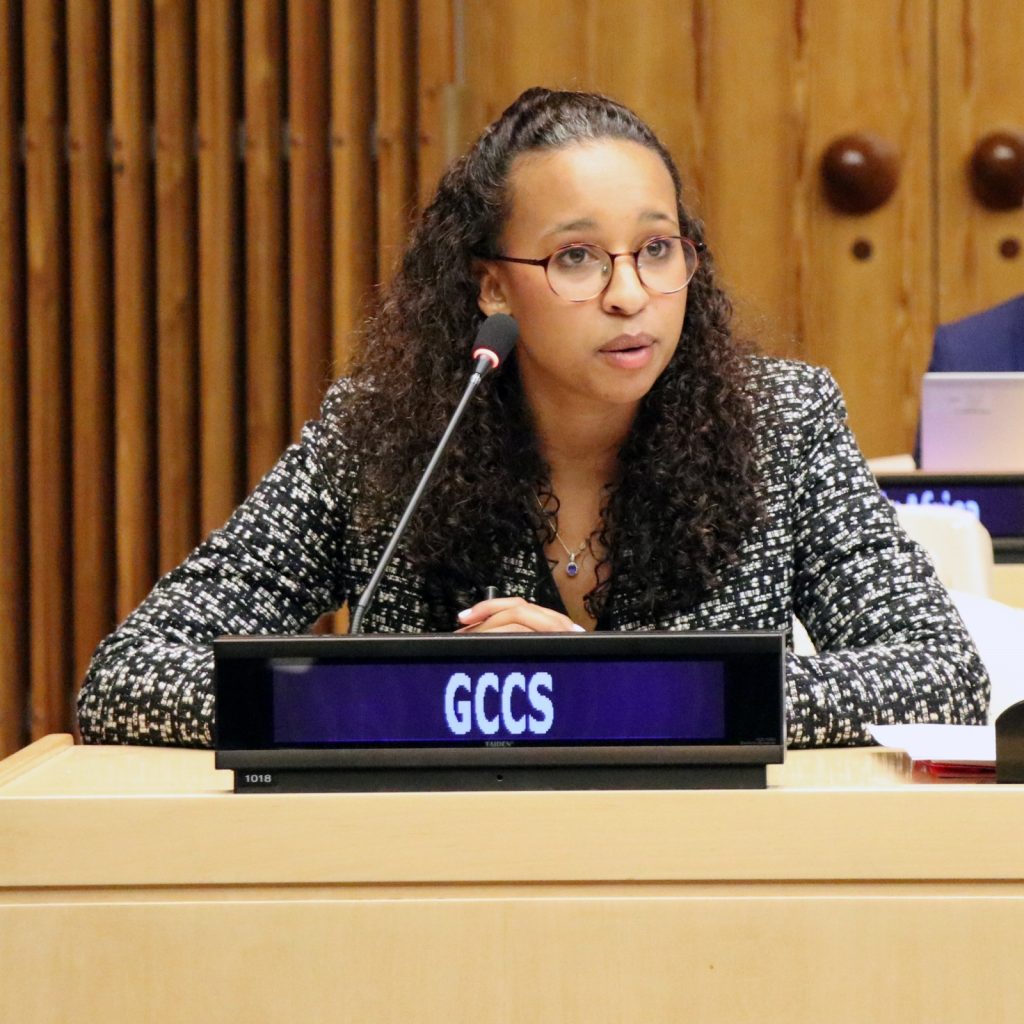
In April 2022, Chania Lackey, Global Center Regional Programs Coordinator for Eastern Africa, addressed the Joint Open Briefing of the Counter-Terrorism Committee and the 1267/1989/2253 ISIL (Da’esh) and Al-Qaida Sanctions Committee on the issue of ISIL in Africa. Chania briefed the Security Council on the issues regarding the financing of ISIL-affiliated terrorist groups in Africa, especially through the trade of minerals and other extractives.
Drawing on the Global Center’s expertise in countering the financing of terrorism and our programming across the African continent, we have observed that ISIL cells and affiliates are largely self-financing, relying on both legal and illicit activities and using formal as well as informal channels to raise money. Notably, there are avenues for detection and disruption at each financing stage—raising, storing, and moving funds. However, doing so requires the private sector to be meaningfully and effectively engaged, a salient barrier in stemming terrorism financing in the region.
While the exploitation of oil and gas by ISIL has attracted significant attention over the last years, terrorist groups on the African context face significant barriers in obtaining the resources and honing the skills required to exploit oil or gas in territories where they are active. On the other hand, we have observed strategic exploits of precious metals and stones—in particular gold, which is present in at least 34 out of 54 African countries. Gold is attractive given its high and stable value, portability, and the cash intensive nature of the gold trade.
Artisanal gold mining has boomed since 2012, producing up to 2 billion US dollars’ worth annually. More recently, gold has drawn attention as a source of terrorism financing, with considerable activity reported in Central and West Africa. Gold poses particular vulnerabilities given the limited anti-money laundering and countering the financing of terrorism (AML/CFT) measures and controls in place across the continent. As such, ISIL affiliates are able to extort artisanal miners, mine gold themselves, and refine, sell, or tax gold that is traded both legally and illegally.
Chania illustrated a theoretical trajectory of how ISIL might extract, transport, and sell gold. She identified key points in the process where authorities might disrupt the process, again emphasizing that such interventions require coordinated engagement by across the public and private sector. In sum, ISIL’s self-financing model presents challenges to the existing CFT architecture, requiring collaboration from private sector entities on the frontlines of detecting and preventing terrorism financing.
In addition to causing the immense suffering of the people of Ukraine, the Russian invasion has significant implications for the international normative and financial system and for peace, security, finance, and counterterrorism efforts. From the functioning of the UN Security Council to the ripple effects of sanctions and cryptocurrency to the challenges of managing the return of foreign fighters participating in the conflict – the impacts cannot be overstated. The Global Center hosted an online discussion which brought together several experts on these subjects for a panel discussion moderated by Ms. Victoria Holt (Global Center Board Director and Dartmouth University) to share their perspectives and reflections.
Dr. Kacper Rekawek (Center for Research on Extremism at the University of Oslo) reflected on the impacts of the conflict and the flow of foreign fighters to Ukraine. Mr. Colin Clarke (Soufan Center) built on Dr. Rekawek’s reflections and emphasized that governments need to be proactive in handling the fallout and challenges related to the return of these individuals by starting to prepare now. Mr. Richard Gowan (Crisis Group) discussed the impacts of the conflict on the multilateral system, particularly the United Nations. Finally, Ms. Liat Shetret (Solidus Labs) reflected on the role that cryptocurrency and cryptoassets play in this conflict and explained how the use of cryptocurrency is impacted by sanctions.
In their final reflections, the panelists offered recommendations and highlighted opportunities and challenges for the international community, including encouraging the United Nations to leverage its advantages in the non-military, non-security aspects of this conflict to help address its unintended consequences.
In recent years, the growth of digital financial services, and more particularly mobile money, has been at the center of financial inclusion initiatives in various countries, notably in sub-Saharan Africa and South Asia. Financial inclusion is featured as a prominent enabler of the Sustainable Development Goals, yet various constraints and barriers prevent eligible adults from accessing digital financial services. Policy and regulatory factors affect the environment in which these services are provided, practical barriers affect an individual’s ability to access and utilize digital financial services, and social and cultural factors affect the customer’s adoption and usage of and trust in digital financial services or its providers. This brief explores the barriers and constraints that hinder digital financial inclusion efforts in jurisdictions that have unbanked populations. It offers recommendations to policymakers and financial sector supervisors on adopting a risk-based approach that overcomes these challenges and enables expanded provision of mobile money and other digital financial services to realize financial inclusion objectives.
Despite a growing volume of research on foreign terrorist fighters (FTFs), there remains limited publicly available research on the financial footprints of FTFs and the facilitation networks that support them. This typology report, produced in partnership between the Asia/Pacific Group on Money Laundering and the Global Center, examines what is known and unknown regarding the financial profiles of FTFs connected to Southeast Asia and explores the collection and utilization of FTF-related financial intelligence in the region. Persistent challenges in detecting FTF financial patterns underscore the critical importance of partnership between law enforcement, intelligence agencies, border control, and financial intelligence units.
This year’s 76th Session of the UN General Assembly aligned with the twenty-year anniversary of the September 11th attacks, giving heightened significance to the annual multilateral discussions. The Global Center team produced a range of commentaries, resources, and analyses that speak to counterterrorism policy over the last two decades and prospective future of counterterrorism.
In an article in The Hill, Executive Director Eelco Kessels reflects on the twenty years since September 11th to underscore the urgency of restoring human rights and centering civil society in global security efforts.
In a Just Security article, Global Center staff reflect on the seventh review of the UN Global Counter-Terrorism Strategy and progress on issues within the United Nations since 2001. And in an IPI Global Observatory article, Legal Analyst Annabelle Bonnefont highlights the need for more meaningful engagement with civil society by the UN as part of its counterterrorism efforts.
Executive Director Kessels delivered remarks as part of the Special meeting of the Counter-Terrorism Committee commemorating the 20th anniversary of the adoption of Security Council resolution 1373 (2001) and the establishment of the Counter-Terrorism Committee.
Finally, the Global Center spotlighted these pieces, additional resources, and reflections from several Advisory Council members on our social media channels using #20YearsofCT.